
Bare soil on a new development, embankment or infrastructure project can quickly become vulnerable to rainfall, surface runoff and erosion.
But not every erosion problem needs the same solution.
A gently graded development slope may simply need vegetation established quickly. A steeper embankment may need additional surface reinforcement, while an unstable slope affected by ground movement can require structural intervention.
That is why choosing between different erosion control methods starts with understanding the problem you are trying to solve.
Green Care Solutions provides erosion control and slope stabilisation for commercial and infrastructure projects, combining hydroseeding with matting, cellular confinement and mechanical stabilisation where required.
Surface Erosion or Slope Instability?
Before comparing systems, it is important to distinguish between two different issues.
Surface erosion occurs when rainfall, runoff or wind removes soil from the face of a slope.
Slope instability involves movement within the ground itself, such as shallow or deeper landslips.
Government-supported Forest Research guidance makes the same distinction: shallow erosion can often be controlled through vegetation and bioengineering, while deeper mass movement may require engineering solutions.
This means hydroseeding, geocell and soil nailing are not simply interchangeable products.
The correct solution depends on:
- Slope gradient
- Soil type
- Drainage
- Runoff
- Length of slope
- Ground stability
- Required lifespan
- Environmental objectives
1. Hydroseeding
Hydroseeding applies a slurry of seed, mulch, fertiliser and water directly onto prepared soil.
The mulch protects the seed, retains moisture and helps create conditions for rapid vegetation establishment.
Once established, plant roots help bind the surface soil and reduce erosion caused by rainfall and runoff.
Green Care Solutions’ commercial hydroseeding service is used across roads, railways, housing developments, embankments, SuDS features and land-restoration schemes.
Hydroseeding works well for:
- Large areas of exposed soil
- Road and rail embankments
- Housing developments
- Amenity areas
- SuDS ponds and swales
- Moderately steep slopes
- Rapid vegetation establishment
It is particularly effective where the ground is fundamentally stable but needs protection from surface erosion.
The limitation is that vegetation takes time to establish. On high-risk slopes, additional immediate protection may therefore be needed.
2. Erosion-Control Matting
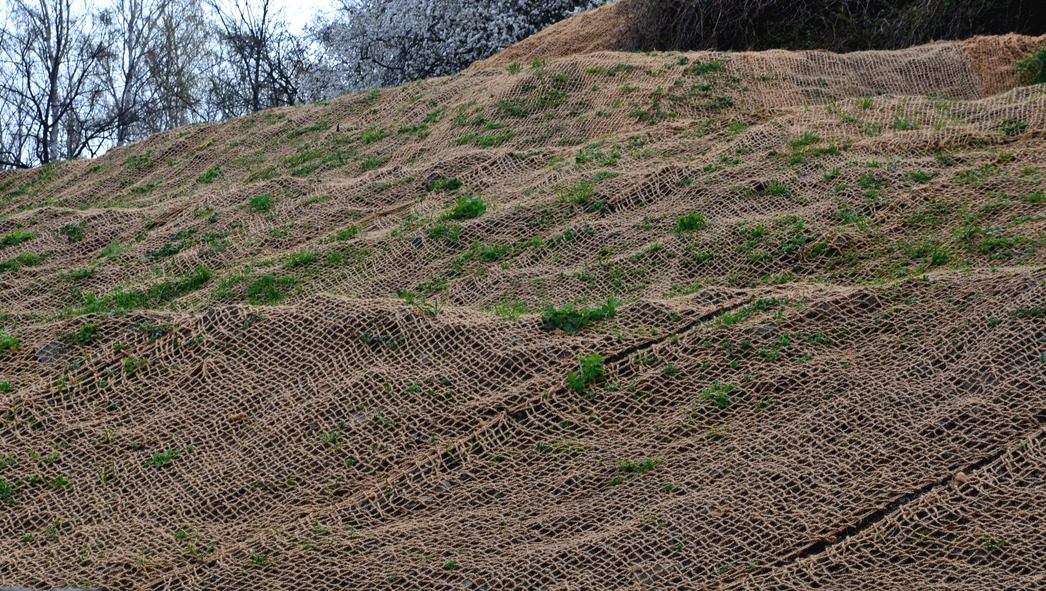
Erosion-control matting provides physical protection over the soil surface while vegetation establishes underneath or through it.
Materials can include biodegradable fibres such as coir or jute as well as longer-lasting synthetic systems.
Matting helps reduce direct rainfall impact and limits movement of loose soil.
Government planning guidance on bank stabilisation notes that natural fibre matting provides a protective surface while allowing vegetation to grow through it, with biodegradable materials eventually degrading once vegetation is established.
Matting may be appropriate for:
- Newly formed slopes
- Watercourse banks
- Areas exposed to runoff
- Slopes where seed needs additional protection
- Projects requiring immediate surface cover
Matting is often combined with hydroseeding.
The mat provides short-term physical protection while the hydroseed mixture establishes the longer-term vegetative cover.
The key is correct installation and anchoring. Poorly secured matting can lift, move or fail before the vegetation becomes established.
3. Geocell or Cellular Confinement Systems
A cellular confinement system, commonly called geocell, provides considerably more physical reinforcement.
Geocell consists of interconnected cells that form a honeycomb-like structure across the slope.
Those cells are filled with material such as:
- Topsoil
- Aggregate
- Gravel
- Other engineered fill
The cell walls physically confine the material and help prevent it moving downslope.
Geocell is therefore particularly useful where ordinary surface vegetation alone may not provide enough protection.
Planning guidance describing TERRAM Geocell explains that the system confines soil or aggregate against erosion from wind and water while allowing drainage and vegetation establishment.
Geocell works well for:
- Steeper embankments
- High runoff areas
- Cut and fill slopes
- Challenging development earthworks
- Slopes requiring vegetation and physical confinement
- Areas where soil needs to be retained in place
Green Care Solutions has used combined cellular confinement and hydroseeding on steep commercial slopes. One recent project involved hydroseeding integrated with a cellular system on a slope of around 70 degrees.
The important point is that geocell controls movement within the surface layer. It does not automatically correct deeper structural instability.
4. Soil Nailing
Where the slope itself is unstable, soil nailing moves into engineering territory.
Soil nails are reinforcement bars installed into the slope to improve its stability.
They can then be combined with mesh, geocell, topsoil, erosion-control matting and vegetation.
Recent UK highway landslip repairs provide a good example. Westmorland and Furness Council used steel soil nails to strengthen a failed embankment, followed by mesh, topsoil, seeding and erosion-control matting.
Soil nailing may be required for:
- Unstable cuttings
- Landslip-prone slopes
- Very steep embankments
- Highway and rail infrastructure
- Slopes requiring structural reinforcement
- Sites where surface erosion is only part of the problem
Unlike hydroseeding or matting, soil nailing normally requires specialist engineering design.
It should therefore be specified after appropriate geotechnical assessment rather than simply selected as an erosion-control product.
Which Erosion Control Method Should You Use?
A simple way to think about the different types of erosion control is:
| Site condition | Possible approach |
| Stable exposed soil | Hydroseeding |
| Surface vulnerable while plants establish | Hydroseeding + matting |
| Steeper slope with surface movement/runoff | Geocell + vegetation/hydroseeding |
| Structurally unstable slope | Soil nailing + engineered facing + erosion control |
In practice, larger infrastructure projects frequently combine several erosion control techniques.
For example, soil nails may provide structural stability, geocell may retain topsoil, matting may protect the immediate surface and hydroseeding may establish the final vegetation.
This layered approach can address both short-term erosion risk and long-term slope performance.
Don’t Forget Drainage
No erosion-control system should be considered without looking at water.
Slope gradient, slope length, soil type and water movement all affect erosion risk. Government guidance notes that steeper slopes experience greater runoff risk because water travels across them more quickly.
Drainage measures may therefore need to form part of the design.
That could involve:
- Crest drainage
- Swales
- Surface-water channels
- Subsurface drainage
- SuDS features
- Managing discharge points
Simply covering a slope without addressing concentrated runoff can leave the underlying cause unresolved.
Erosion and Sediment Control During Construction
Another distinction is between permanent erosion control and temporary erosion and sediment control during the construction phase.
Bare earthworks can produce runoff before permanent landscaping is established.
Temporary measures may therefore be required to prevent sediment leaving the site while the final slope treatment develops.
The permanent solution should then be selected according to the intended land use, slope conditions and long-term maintenance requirements.
Green Care works with contractors and developers to integrate hydroseeding and erosion control into wider construction and landscaping programmes rather than treating vegetation as an afterthought.
Frequently Asked Questions
What is the best erosion control method for a steep slope?
It depends on whether the problem is surface erosion or structural instability. A stable steep slope may suit geocell, matting and hydroseeding, while an unstable slope may require engineered reinforcement such as soil nailing.
Can hydroseeding be used with erosion-control matting?
Yes. The two methods are often complementary. Matting provides immediate surface protection while vegetation established through hydroseeding develops roots that provide longer-term soil stabilisation.
What is a cellular confinement system?
A cellular confinement system, or geocell, is a three-dimensional grid that holds soil or aggregate within individual cells. This helps restrict surface material movement and can provide a stable medium for vegetation on steeper or more erosion-prone slopes.
Choosing the Right Erosion Control Solution
There is no single system that suits every slope.
Hydroseeding provides rapid vegetation establishment. Matting offers immediate surface protection. Geocell physically confines soil on more challenging gradients, while soil nailing can reinforce slopes where deeper instability is present.
Green Care Solutions provides commercial erosion control and hydroseeding for infrastructure, housing and commercial projects nationwide.
The team can assess the slope, erosion risk and project requirements before recommending an appropriate combination of systems.
To discuss an erosion-control project, contact Green Care Solutions or call 0115 654 6586.